Blog Posts
Ephedrine API Certificate of Analysis Requirements
Sep
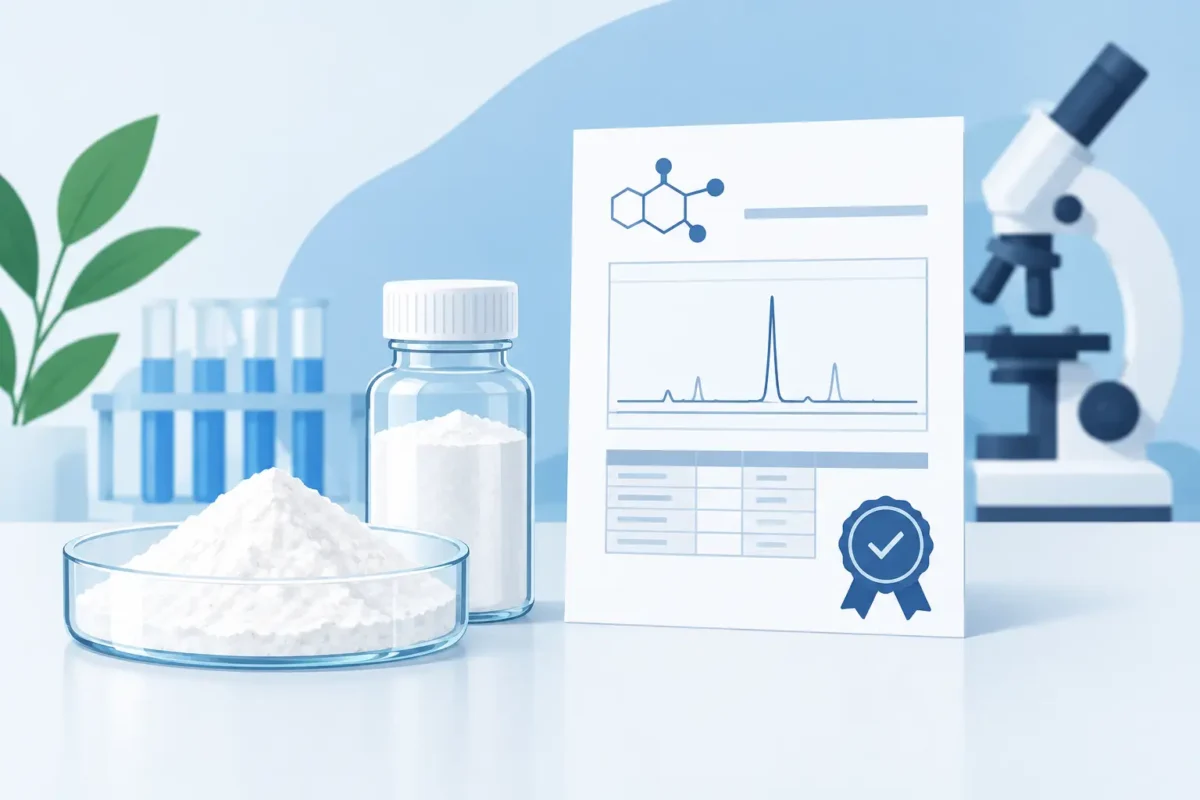
A low price and a stated purity percentage are not enough to qualify an active pharmaceutical ingredient for serious procurement. Ephedrine API certificate of analysis requirements exist to give a buyer a batch-specific record of what was tested, how it was tested, and whether the material meets the agreed specification. For regulated stimulant-related materials, that record is a core part of quality review, not a marketing attachment.
A proper certificate of analysis, commonly called a COA, should allow an authorized buyer or quality team to connect a physical container to a defined production batch, an approved specification, and traceable analytical results. If those connections are missing, claims such as pharmaceutical grade or high purity remain difficult to verify.
What an Ephedrine API COA Must Establish
The central purpose of a COA is simple: it documents whether a specific batch conforms to the specification established for that material. It does not merely state that a product is ephedrine or that it passed an unspecified internal check.
For ephedrine API, the document should clearly identify the material, including the correct chemical form. Ephedrine and ephedrine hydrochloride are not interchangeable descriptions. The specification, label, test methods, and result presentation must all match the form actually supplied.
A credible COA also identifies the manufacturer or testing organization, the batch or lot number, the date of manufacture or retest, and the date the certificate was issued. These details are what make the document useful during receiving, release, storage review, investigation, or recall activity.
The results need to be reported against defined acceptance criteria. A result without a limit has little practical value. For example, an assay value should be shown alongside the approved assay range, with a clear pass or conforms disposition where appropriate. The same principle applies to identity, moisture, impurities, residual solvents, and physical characteristics.
Core Ephedrine API Certificate of Analysis Requirements
The exact specification depends on the intended use, applicable pharmacopeial standard, customer quality agreement, and legal jurisdiction. Still, a serious ephedrine API COA typically addresses several core quality attributes.
Identity and chemical form
Identity testing confirms that the material is the stated API and not a substituted, mislabeled, or mixed compound. The COA should name the test method or reference standard used, rather than relying on a bare statement that identity is positive.
For an API supplied as a salt, the chemical form must be identified consistently throughout the document. A discrepancy between the sales description, container label, and COA is a stop-and-review issue. Buyers should not assume that a reported assay can be compared directly across different forms of ephedrine.
Assay and potency
Assay is often the first figure buyers look for because it measures the amount of active component relative to the specification. Yet a high assay result does not prove overall quality by itself. A batch may appear potent while still presenting unacceptable impurity, solvent, or documentation concerns.
The COA should state the assay method, result, acceptance range, and reporting basis. Reporting basis matters because results may be expressed on an as-is, dried, or anhydrous basis. If a buyer is comparing batches, these distinctions can materially affect the interpretation of potency.
Related substances and impurities
Impurity control is where a COA becomes more meaningful than a simple purity claim. The document should include relevant related substances or degradation products, individual impurity limits where applicable, and total impurity limits. Results should be numerical when practical, not simply described as acceptable.
A serious review also asks whether the methods used are suitable for the material and whether the reported limits match the agreed specification. A vague “99% purity” statement may conceal the absence of meaningful impurity profiling. For regulated material, the question is not only how much desired compound is present, but what else may be present and at what level.
Residual solvents, water, and physical properties
Depending on the manufacturing route and specification, residual solvent testing may be required. The COA should identify tested solvents and show results against established limits. A generic statement such as “solvents comply” is less useful than batch-specific values or a clear reference to the approved method and limits.
Water content or loss on drying can affect handling, assay interpretation, stability, and storage decisions. Physical appearance, color, solubility, melting range, particle characteristics, and other properties may also be included when they are relevant to the customer specification or intended manufacturing process.
Not every test belongs on every COA. That is a specification decision. But omitted testing should be understood and justified through the quality system, not ignored because the paperwork looks polished.
Documentation That Makes a COA Traceable
A clean layout is not proof of quality. Traceability is. Every certificate should contain enough information for the recipient to verify that the document belongs to the batch received.
At minimum, buyers should expect a unique COA number, supplier or manufacturer name and address, material name, lot number, batch size or relevant batch identification, manufacturing date, retest or expiry date where assigned, and release authorization. The document should also include the specification version or reference used for evaluation.
Analytical methods should be identified by method number, pharmacopeial reference, or validated internal procedure. This matters when a customer needs to understand whether a result was generated using a recognized compendial method, an approved in-house method, or an outsourced laboratory procedure.
Release authorization must be meaningful. A certificate should show the name, role, signature or approved electronic authorization, and release date of the authorized quality representative. A spreadsheet with no accountable issuer, no controlled format, and no batch linkage should not be treated as final release documentation.
How to Review a COA Before Accepting Material
Start by matching the container label, purchase documentation, and COA. The product name, chemical form, lot number, quantity, and supplier identity should align. Any mismatch deserves clarification before the batch enters usable inventory.
Next, compare each reported result to the specification that was agreed before purchase. Do not rely solely on a supplier’s internal limits if your operation requires a different standard. Wholesale buyers, contract manufacturers, and authorized research or industrial customers may each have different documentation needs.
Then check dates and status. A retest date is not a casual detail. Material beyond its approved retest date should not be assumed suitable merely because it has been stored in a sealed container. Stability status, storage conditions, and any required retesting should be reviewed by qualified personnel.
Finally, assess the COA in context. A certificate supports quality assurance, but it is not a substitute for supplier qualification, legal authorization, transport controls, chain-of-custody review, or independent confirmation testing when risk warrants it. The appropriate level of verification depends on the intended use, batch size, jurisdiction, and supplier history.
Common COA Red Flags
Some problems are immediately visible. A COA that lacks a batch number, has results without specifications, uses inconsistent material names, or contains unexplained edits should be held for review. So should a document that reports only assay while making broad claims about pharmaceutical quality.
Other red flags require closer attention. Identical values repeated across multiple lots can indicate template copying rather than batch-specific testing. A certificate issued long after a batch’s stated release date may be legitimate, but it requires an explanation. Missing method references, incomplete impurity data, or a release signature from an unidentified party all weaken confidence.
Buyers should also be cautious about certificates that make legal or pharmaceutical claims without stating the applicable standard. “USP grade,” “GMP,” and “pharmaceutical grade” are not interchangeable labels. Each claim should be supported by the documentation, quality system, and permitted use of the material.
Legal Controls Remain Separate From Quality Documentation
A complete COA does not authorize possession, importation, sale, compounding, or use. Ephedrine is subject to significant federal, state, and international controls, and requirements can differ based on the material form, quantity, transaction type, and destination.
Authorized purchasers should verify licensing, recordkeeping, shipment restrictions, and applicable controlled-chemical obligations before placing or receiving an order. Privacy in commercial communication does not remove compliance duties. For any regulated supply arrangement, accurate records and lawful handling protect both the buyer and the supplier.
For quality-conscious purchasers, the practical standard is straightforward: request the batch-specific COA before acceptance, read it against a written specification, and treat gaps as a reason to pause rather than a reason to assume. A supplier that can support its material with clear, consistent documentation gives you a stronger basis for responsible purchasing and controlled handling.
