Blog Posts
How to Read Certificate Analysis for Powders
Sep
A certificate of analysis is only useful if it belongs to the material in front of you. When learning how to read certificate analysis documents, start with the lot number on the container, not the purity percentage in large print. A polished PDF cannot verify a powder if its batch identifier, date, supplier details, or test scope do not match.
For chemical powders, a COA should help answer practical questions: Is this the stated compound? What was actually measured? Which impurities were checked? Was the sample tested recently and by a credible laboratory? Reading those details carefully is part of responsible purchasing, storage, handling, and regulatory compliance.
Start With Product and Batch Identification
The top section should identify the material clearly. Look for the product name, chemical name where applicable, lot or batch number, manufacturing date, retest or expiration date, and the date the certificate was issued. The lot number must match the label on the sealed container exactly. A near match is not a match.
Also check whether the certificate identifies the manufacturer, distributor, or testing laboratory. A supplier-issued COA may be useful, but an independent laboratory report usually provides stronger evidence because the testing party is separate from the seller. Neither document is meaningful without traceability to the specific batch.
A legitimate report normally includes a document number, revision number, signature or approval field, and contact information for the issuing organization. Missing identifiers do not automatically prove a document is false, but they reduce its value. Ask for clarification before relying on it.
How to Read Certificate Analysis Specifications
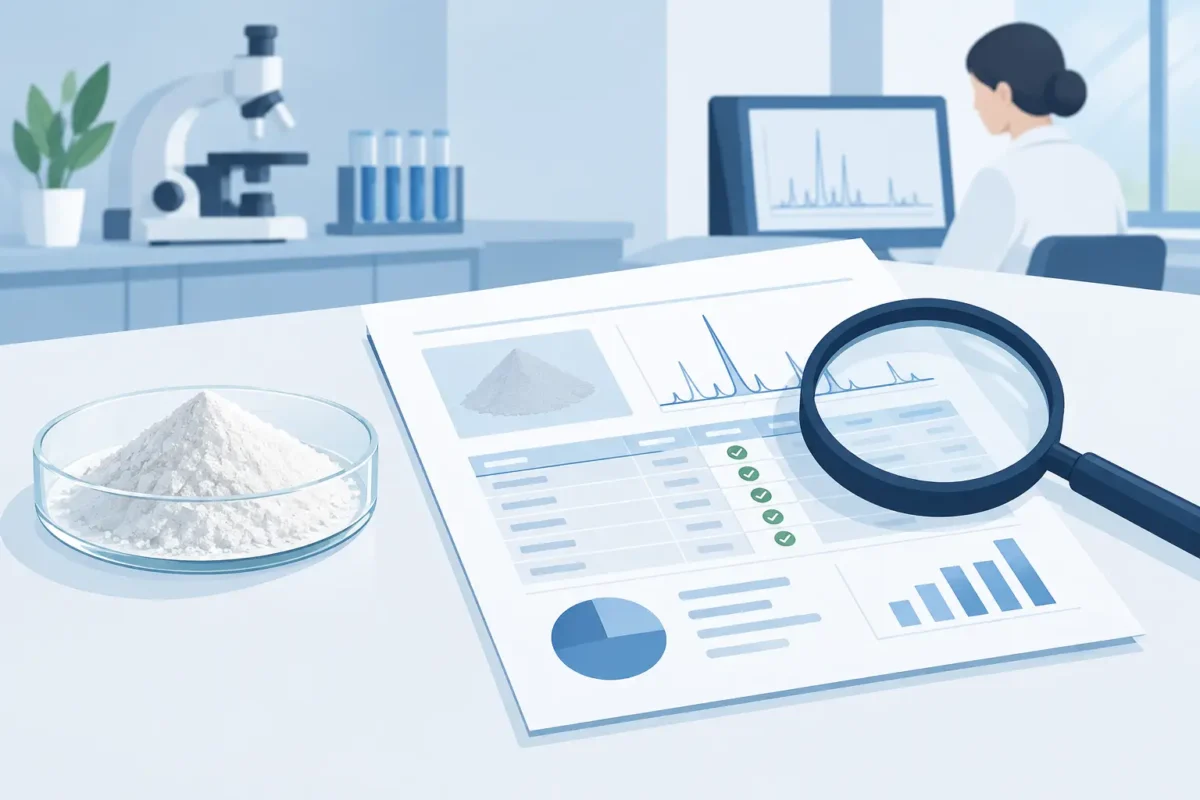
Most COAs use a table with four basic columns: the test item, specification, result, and method. The specification is the acceptable limit. The result is what the laboratory found. The method explains how the result was obtained.
For example, an assay specification might state “not less than 99.0%,” while the reported result is 99.4%. That result passes the stated requirement. However, the number needs context. A 99.4% result on a dry basis can differ from a 99.4% result as received if the powder contains water or volatile material.
Pay attention to units. Assay may be reported as percent by weight, milligrams per gram, or another defined basis. Impurities may appear in parts per million, parts per billion, or percentages. A result of 500 ppm is 0.05%, which can sound very different depending on how it is presented.
The most useful COA does not simply say “pass.” It shows the numerical result and the acceptance criterion. A pass/fail-only report gives less information about how close a batch is to its limit.
Identity Testing Comes First
Identity testing confirms that the sample is consistent with the named material. Common techniques can include infrared spectroscopy, chromatography, or other validated analytical methods. A COA may state “identification: conforms,” but stronger documentation identifies the method used.
Identity is not the same as purity. A sample can test positive for the intended compound and still contain unwanted related substances, moisture, solvents, or other contaminants. Treat identity and assay as separate checks.
For regulated or stimulant-related compounds, accurate identity documentation matters especially because naming conventions, salt forms, and concentrations can be misunderstood. Confirm that the stated chemical form on the COA matches the product label and the material you intended to source.
Assay Shows Amount, Not the Entire Quality Picture
Assay is often the first number buyers look for. It estimates the amount of the stated active chemical in the tested sample. Higher is not automatically better if the report does not explain the basis, method, and accompanying impurity profile.
Read the test method beside the assay. High-performance liquid chromatography, gas chromatography, titration, and related methods can produce useful results, but the right method depends on the compound and specification. A specific method reference, such as a pharmacopeial procedure or validated in-house method, is more informative than a vague statement like “tested in lab.”
Check whether the assay is “as is,” “anhydrous,” or “on a dried basis.” If moisture is present, a dry-basis result may look higher than the amount in the powder as received. The COA should make that distinction clear rather than leaving buyers to guess.
Check Impurity Results, Not Just the Headline Number
A clean assay result does not replace impurity testing. Depending on the material and intended lawful use, relevant COA categories may include related substances, residual solvents, heavy metals or elemental impurities, moisture, microbial limits, and unidentified peaks.
Related substances are chemically similar compounds that can arise during manufacturing or degradation. A report should state the limit for each specified impurity and, where relevant, the limit for total impurities. If a chromatogram or detailed impurity table is available, review whether any unknown peak is present and how it was handled.
Residual solvent testing matters when manufacturing involves organic solvents. The report should name the solvents tested, show limits, and provide results. A generic line reading “residual solvents: pass” is less useful than a named panel with numerical values.
Moisture can affect powder weight, stability, flow, and assay interpretation. It may be reported as water content, loss on drying, or Karl Fischer moisture. These tests are not interchangeable, so the method should be stated. Hygroscopic materials can change after testing if containers are opened or stored poorly.
Elemental impurity or heavy-metal testing should identify the relevant elements and limits. Be cautious with outdated reports that list only a broad “heavy metals” result without specifying what was measured. The level of testing needed depends on the material, intended lawful application, and applicable regulations.
Understand Detection Limits and “Not Detected” Claims
“Not detected” does not always mean zero. It usually means the analyte was below the laboratory’s limit of detection or limit of quantitation. The distinction matters.
The limit of detection is the lowest level a method can reliably notice. The limit of quantitation is the lowest level it can measure with acceptable accuracy. If a COA reports “ND,” look for the reporting threshold. A solvent listed as “not detected below 10 ppm” provides more information than a bare “ND.”
This is where broad purity claims can become misleading. A material can meet a 99% assay specification while still having impurity levels that are unacceptable for a particular application. The appropriate standard depends on what the material is, how it will be handled, and what laws or quality rules apply.
Verify Dates, Storage Conditions, and Sample Integrity
A COA reflects the sample tested on a specific date. It does not guarantee that every later container remains unchanged. Review the manufacture date, test date, retest date, and expiration date. An old certificate may still describe a batch, but it may not support a current quality claim if the material has aged beyond its approved retest period.
Storage instructions deserve the same attention. Many powders require protection from heat, light, humidity, or air exposure. If the COA or product specification calls for a tightly sealed, cool, dry environment, opening the container repeatedly can affect the material over time.
Consider the chain of custody as well. Was the test sample drawn from the same sealed lot you received? Did the container arrive intact, correctly labeled, and free from visible damage? A valid report cannot correct a compromised shipment or improper storage after delivery.
Red Flags That Deserve a Direct Question
Several warning signs should pause a purchase or use decision. These include a COA with no batch number, a lot number that does not match the package, impossible-looking dates, copied formatting with inconsistent product names, missing methods, and results that are identical across every batch.
Be cautious when every test result is rounded to a perfect number, when a report claims unusually broad testing without naming methods, or when the laboratory cannot be identified. A supplier should be able to explain whether the document is a manufacturer COA, an internal quality-control record, or an independent third-party analysis.
A COA is also not a legal clearance document. It does not establish that a material may be purchased, possessed, imported, exported, or used in a particular jurisdiction. Buyers are responsible for checking applicable federal, state, local, and international requirements before ordering or handling regulated chemicals.
Ask for the Right Documentation
If the report leaves questions unanswered, request the batch-specific COA, the testing laboratory name, analytical method references, and a clear explanation of assay basis and impurity limits. For higher-volume orders, it is reasonable to ask whether an independent test report is available for the same lot.
Do not rely on a COA alone for safety decisions. Follow lawful handling requirements, keep powders in their original labeled containers, prevent access by children or unauthorized individuals, and do not use a material when identity, condition, or documentation is uncertain. A supplier that takes quality seriously should welcome specific questions rather than pressure you to ignore them.
The best certificate is not the one with the largest purity number. It is the one that clearly connects a real batch to transparent methods, meaningful limits, and results you can verify before you handle the material.
