Blog Posts
Ephedrine CAS Number for Identity Checks
Oct
A correct ephedrine cas number is a basic identity check, but it is not a shortcut for proving purity, potency, or legal status. When material is labeled simply as “ephedrine,” buyers and handlers need to know whether that label refers to the free base, a hydrochloride salt, a sulfate salt, or a different related compound entirely. A few digits can separate substances with different formula weights, handling records, and regulatory treatment.
For anyone reviewing a product label, a certificate of analysis, a warehouse record, or a supplier specification, CAS information should be read alongside the full chemical name, salt form, batch number, and supporting analytical documentation. Treat it as the first checkpoint, not the final answer.
What Is the Ephedrine CAS Number?
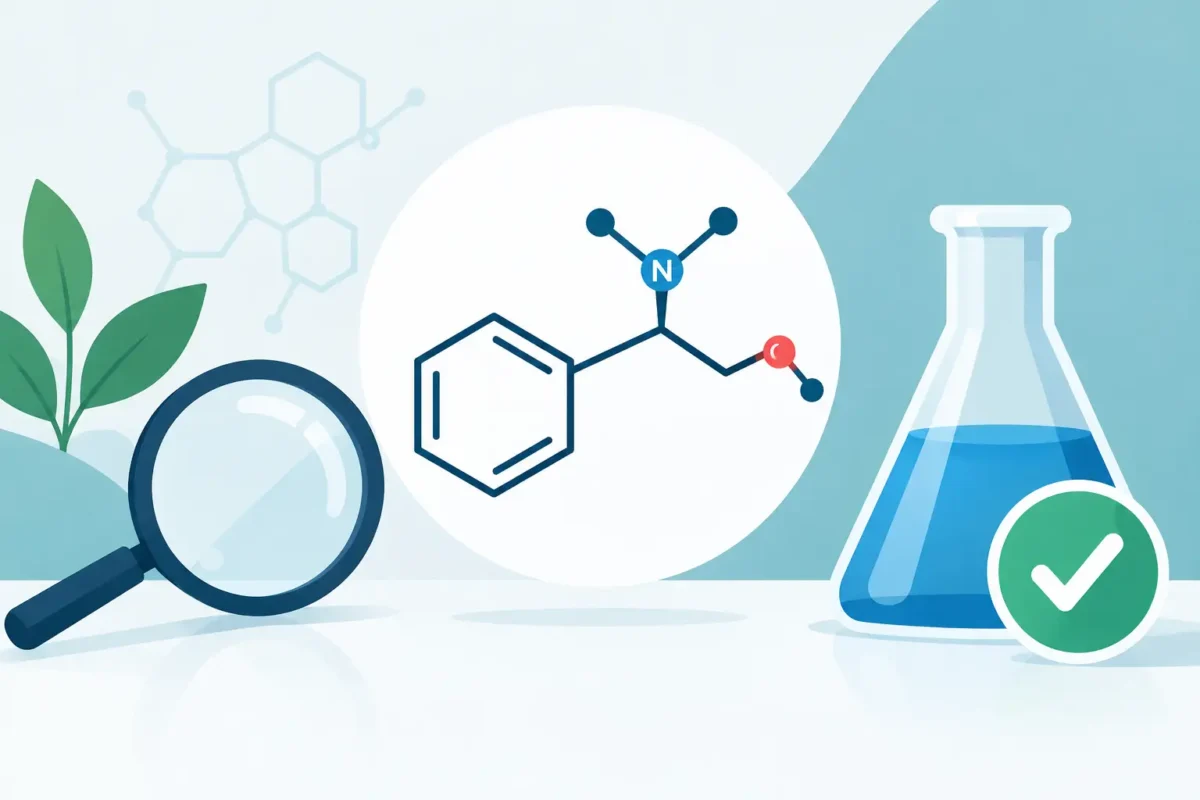
The CAS number commonly assigned to ephedrine free base is 299-42-3. CAS stands for Chemical Abstracts Service. A CAS Registry Number is a numerical identifier assigned to a specific chemical substance in scientific and commercial records.
Its main value is precision. Common names can be inconsistent across listings, countries, and product documents. “Ephedrine” may be used as a broad product name even where the actual material is ephedrine hydrochloride or another salt form. The CAS number helps narrow down the exact substance being referenced.
A CAS number is not a grade designation. It does not mean pharmaceutical grade, laboratory grade, or any other quality level. It also does not certify that a container holds the material claimed on its label. Those claims require a credible chain of documentation and, where appropriate, independent testing.
Free Base, HCl, and Other Forms Are Not Interchangeable
The most common mistake in ephedrine documentation is treating the parent compound and its salt forms as if they share one identity. They do not. Each form has its own chemical composition and generally its own CAS number.
Ephedrine free base is identified as CAS 299-42-3. Ephedrine hydrochloride, commonly written as ephedrine HCl, is identified as CAS 50-98-6. Ephedrine sulfate is also a separate material with its own registry entry and molecular weight.
That distinction matters for several reasons. A salt adds mass to the molecule, so a stated weight of ephedrine HCl is not chemically identical to the same stated weight of ephedrine free base. The physical characteristics may also differ, including solubility, storage behavior, labeling requirements, and how the material appears in technical records.
A label that says “ephedrine HCl” while listing 299-42-3 deserves clarification. It may be a transcription error, an overly broad catalog entry, or a sign that the seller’s documentation is not being controlled carefully. None of those possibilities should be ignored when dealing with a regulated stimulant-related chemical.
Related compounds have different identifiers
Ephedrine is often discussed near pseudoephedrine because the compounds are closely related and subject to significant regulatory attention. They are not the same chemical. Pseudoephedrine free base is commonly identified by CAS 90-82-4, while pseudoephedrine hydrochloride is commonly listed as CAS 345-78-8.
The names look similar, but a correct CAS number prevents the records from being mixed. That matters especially when inventories, compliance files, shipping papers, and analytical reports are reviewed by different people.
How to Read a Label Beyond the CAS Number
A dependable label should do more than display a chemical name and a registry number. It should allow the container to be matched to its supporting records without guesswork.
At minimum, compare the CAS number against the stated chemical form, then check that the batch or lot number matches the accompanying certificate of analysis. The net quantity, date of manufacture or retest date, supplier identity, and storage instructions should also be present where applicable. If a document identifies a material as ephedrine free base but gives the molecular weight or formula for ephedrine HCl, the record is internally inconsistent.
The strongest identity review combines four distinct checks:
- the full chemical name and stated salt form;
- the CAS number associated with that exact form;
- the lot number matched to batch-specific analytical records; and
- a certificate of analysis that identifies the testing method, result, date, and responsible laboratory or quality unit.
A generic document with no lot number is weak evidence. So is a certificate that repeats marketing language about “high purity” without reporting a method, specification, or test result. A CAS number can be copied onto any label. Traceable records are harder to fake and easier to audit.
Why CAS Numbers Do Not Prove Purity
A CAS Registry Number identifies what a substance is supposed to be. It cannot tell you whether the container has been diluted, contaminated, degraded, mislabeled, or substituted. This is where quality claims need to be separated from identity claims.
Purity is an analytical question. Depending on the material and intended lawful use, relevant records may include assay results, chromatographic identity testing, water content, residual-solvent screening, heavy-metal limits, and impurity profiling. The appropriate panel depends on the material’s specification and the regulated setting in which it will be used.
There is also a practical trade-off. Extensive testing adds cost and time, while bare-bones paperwork may be faster and cheaper. For regulated chemicals, low-friction documentation is not necessarily a benefit. Missing data can create larger problems later, especially if the material must be returned, investigated, stored for a long period, or accounted for during an inspection.
Stereochemistry Adds Another Layer
Ephedrine is not merely a single flat name on a label. It has stereochemical forms, meaning the three-dimensional arrangement of atoms can matter. Technical documents may use more specific nomenclature, such as (1R,2S)-ephedrine, or identify an optical form through additional specifications.
This does not mean every commercial record must be written like a research paper. It does mean that a buyer should not assume a basic name resolves every identity question. If stereochemical composition matters to a documented application, request records that state it clearly rather than relying on a broad product title.
The same principle applies to labels that use older names, abbreviated names, or nonstandard spelling. The CAS number is useful for cross-checking, but the full specification should still describe the actual material in plain, unambiguous terms.
Storage, Safety, and Record Control
Ephedrine-containing materials should remain in their original, clearly labeled containers whenever possible. Keep the label legible, separate the material from incompatible substances, and follow the supplier’s safety documentation and applicable site procedures. Do not rely on a CAS number to replace a safety data sheet or hazard communication program.
Access control is also part of sound recordkeeping. Regulated stimulant-related materials should not be left in unmarked secondary containers or moved into storage without a documented inventory trail. A clear chain of custody protects the handler as much as the material. It helps resolve questions about quantity, lot identity, storage time, and who had access.
If a container is damaged, unlabeled, or inconsistent with its documents, isolate it from ordinary inventory until its identity can be resolved through appropriate internal procedures or qualified testing. Guessing based on appearance is not an identity method.
Legal Status Depends on More Than the Number
In the United States, ephedrine and related chemicals may be subject to federal controls, state requirements, reporting obligations, and restrictions that vary by form, quantity, intended use, and transaction type. International rules can be stricter, different, or subject to rapid change. A CAS number does not authorize possession, importation, exportation, distribution, or use.
For that reason, responsible handling begins before a shipment is accepted or material is transferred. Confirm the applicable requirements for the exact substance, salt form, location, quantity, and lawful intended use. Documentation that is technically accurate but legally incomplete can still create serious exposure.
A good ephedrine identity check is simple in principle: match the name, form, CAS number, batch records, and legal documentation before treating any label as reliable. When one part does not match, pause the transaction or handling process and resolve the discrepancy. That caution is far less costly than trying to explain an avoidable error after the fact.
