
Blog Posts
Ephedrine Chemical Properties and Safety Facts
Oct
Ephedrine chemical properties matter because this is not a casual consumer ingredient. Ephedrine is a regulated sympathomimetic stimulant with meaningful cardiovascular, neurological, and legal risks. Its salt form, molecular structure, stability, and stereochemistry all influence how it behaves in a laboratory, a pharmaceutical setting, and the body.
For anyone reviewing ephedrine HCl or related materials, chemical specifications should never be treated as a substitute for lawful sourcing, qualified testing, or medical oversight. A powder can look consistent while containing the wrong compound, an unsuitable salt, or contaminants that cannot be identified by appearance alone.
What Is Ephedrine?
Ephedrine is an alkaloid associated with plants in the Ephedra genus, though it can also be produced synthetically. Chemically, it belongs to the phenethylamine family and shares structural features with other compounds that stimulate adrenergic receptors.
Its pharmacological activity is tied to the sympathetic nervous system. Ephedrine can increase release of norepinephrine and stimulate adrenergic pathways, which may raise heart rate, blood pressure, alertness, and respiratory activity. Those effects are the reason ephedrine has recognized medical uses under controlled conditions, but they also explain why unsupervised use can become dangerous quickly.
The free-base form is commonly described by the molecular formula C10H15NO. In commercial and pharmaceutical contexts, ephedrine is often encountered as a salt, particularly ephedrine hydrochloride. The salt designation is not a minor labeling detail. It changes the material’s formula weight, physical behavior, and compatibility with a given formulation.
Core Ephedrine Chemical Properties
Molecular structure and functional groups
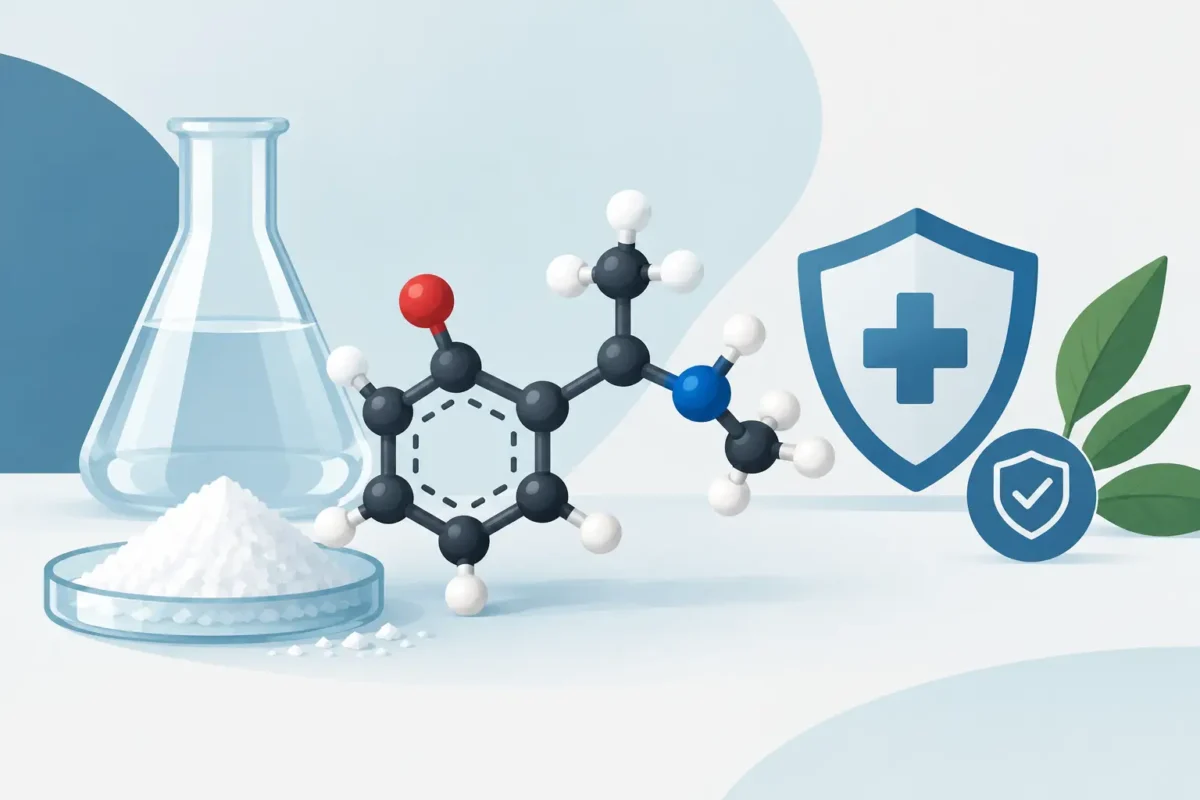
Ephedrine contains a phenyl ring, a hydroxyl group, and a secondary amine. The amine is basic, meaning it can accept a proton and form stable salts with acids. This is why hydrochloride forms are common: converting a basic free base into a salt can improve consistency and water solubility for regulated pharmaceutical applications.
The hydroxyl group contributes to ephedrine’s polarity and affects how it partitions between water-based and nonpolar environments. Compared with a less polar stimulant structure, ephedrine’s chemistry influences its absorption, distribution, and analytical behavior.
Basicity and pKa behavior
As a basic amine, ephedrine can exist in protonated or unprotonated forms depending on pH. In acidic conditions, more of the molecule is present in a positively charged, protonated state. In more alkaline conditions, a larger portion may exist as the uncharged free base.
This acid-base behavior affects solubility and testing. It also helps explain why free-base ephedrine and ephedrine HCl should not be assumed to have identical handling characteristics or equivalent mass-based strength. A specification sheet must clearly identify which form is being discussed.
Solubility
Ephedrine hydrochloride is generally more soluble in water than the free-base form. That property makes salt forms more practical for certain legitimate pharmaceutical preparations, where uniform dispersion and predictable concentration are required.
Solubility is not a purity test. A material dissolving in a liquid does not establish identity, pharmaceutical grade, or freedom from adulterants. Reliable identity and purity determination require validated analytical methods performed by qualified laboratories.
Appearance and physical form
Pure ephedrine salts are often described as white or nearly white crystalline powders. However, appearance is one of the weakest indicators of quality. Many unrelated powders can be white, crystalline, odorless, or visually uniform.
Color changes, clumping, unusual odor, or inconsistent texture can indicate exposure to moisture, degradation, or contamination. Still, a normal appearance does not prove a material is safe. Visual inspection can identify obvious concerns, not confirm chemical identity.
Why Stereochemistry Changes the Picture
One of the most significant ephedrine chemical properties is chirality. Ephedrine has more than one chiral center, meaning it can exist in different stereoisomeric forms. These forms have the same basic atomic composition but differ in three-dimensional arrangement.
That difference can affect biological activity. Ephedrine and pseudoephedrine are closely related stereoisomers, but they are not interchangeable. Their receptor activity, intended use, regulatory treatment, and physiological effects can differ. Product labels that use these names loosely create a serious quality and safety concern.
For regulated materials, stereochemical identity should be part of the specification. A credible analytical record may distinguish the compound from related isomers and report purity in a way that is meaningful for the stated form. Broad claims such as “high purity” are not enough without documentation, appropriate testing methods, and a lawful chain of custody.
Stability, Moisture, and Storage Considerations
Ephedrine materials should be protected from conditions that can compromise a chemical product. Moisture is a recurring concern for powders because it can cause caking, alter flow characteristics, and complicate accurate analytical sampling. Repeated exposure to humid air is especially undesirable once a container has been opened.
Light and excessive heat can also create avoidable stability questions. Storage should follow the requirements on the original regulated product label, safety documentation, and applicable local rules. Keep any authorized material in its labeled container, secured against access by children, pets, and unauthorized persons.
Do not transfer powders into food containers, unmarked bags, or improvised storage vessels. Mislabeling is a preventable source of accidental exposure. It also makes it impossible to maintain reliable traceability if an issue arises later.
How Quality Is Actually Evaluated
The difference between a product claim and a defensible chemical specification is analytical evidence. Laboratory evaluation may use techniques such as chromatography, spectroscopy, water-content testing, and impurity profiling. The appropriate method depends on the question being answered: identity, assay, residual solvents, related substances, or contamination.
A meaningful certificate of analysis should match the specific lot being evaluated, identify the material and salt form clearly, and include test methods and results that a qualified reviewer can assess. A generic document without a lot reference, a date, or a defined testing scope has limited value.
Even a documented result has boundaries. A certificate does not override local law, does not make a regulated substance appropriate for self-treatment, and does not eliminate the possibility of storage or chain-of-custody problems after testing.
Health Risks Connected to Ephedrine’s Chemistry
Ephedrine’s stimulant activity is not separate from its chemical identity. The same adrenergic effects that can increase alertness or open airways can also place stress on the cardiovascular system. Potential adverse effects include palpitations, elevated blood pressure, anxiety, tremor, insomnia, agitation, nausea, and headache.
Risk can increase when ephedrine is combined with caffeine, other stimulants, certain decongestants, some antidepressants, or medications that affect blood pressure and heart rhythm. People with cardiovascular disease, uncontrolled hypertension, thyroid conditions, glaucoma, anxiety disorders, or a history of substance misuse may face added risk.
Severe symptoms require urgent medical attention. Chest pain, fainting, severe headache, confusion, seizures, irregular heartbeat, or trouble breathing should never be managed by waiting to see if symptoms pass. Contact emergency services or poison control immediately when exposure is suspected.
Regulation Is Part of the Product Profile
Ephedrine is subject to substantial regulation in the United States and many other countries because of its medical risks and diversion potential. Rules can differ by form, concentration, product category, location, and intended use. Importation, possession, sale, and distribution may carry restrictions even when a material is described as pharmaceutical grade.
The responsible approach is straightforward: verify the law where you live, follow any prescription or professional requirements, and do not rely on vague claims about international availability or discreet shipping. Privacy does not remove legal obligations, and it does not make a prohibited transaction safe.
The clearest way to assess ephedrine is to treat its chemistry and its risk profile as one subject. Accurate labeling, verified identity, lawful oversight, and respect for its stimulant effects matter far more than a powder’s appearance or a marketing claim.
